Now I know, I will never see you again

Ana Jikia, Gaia Vincensini

5 September — 31 October 2026
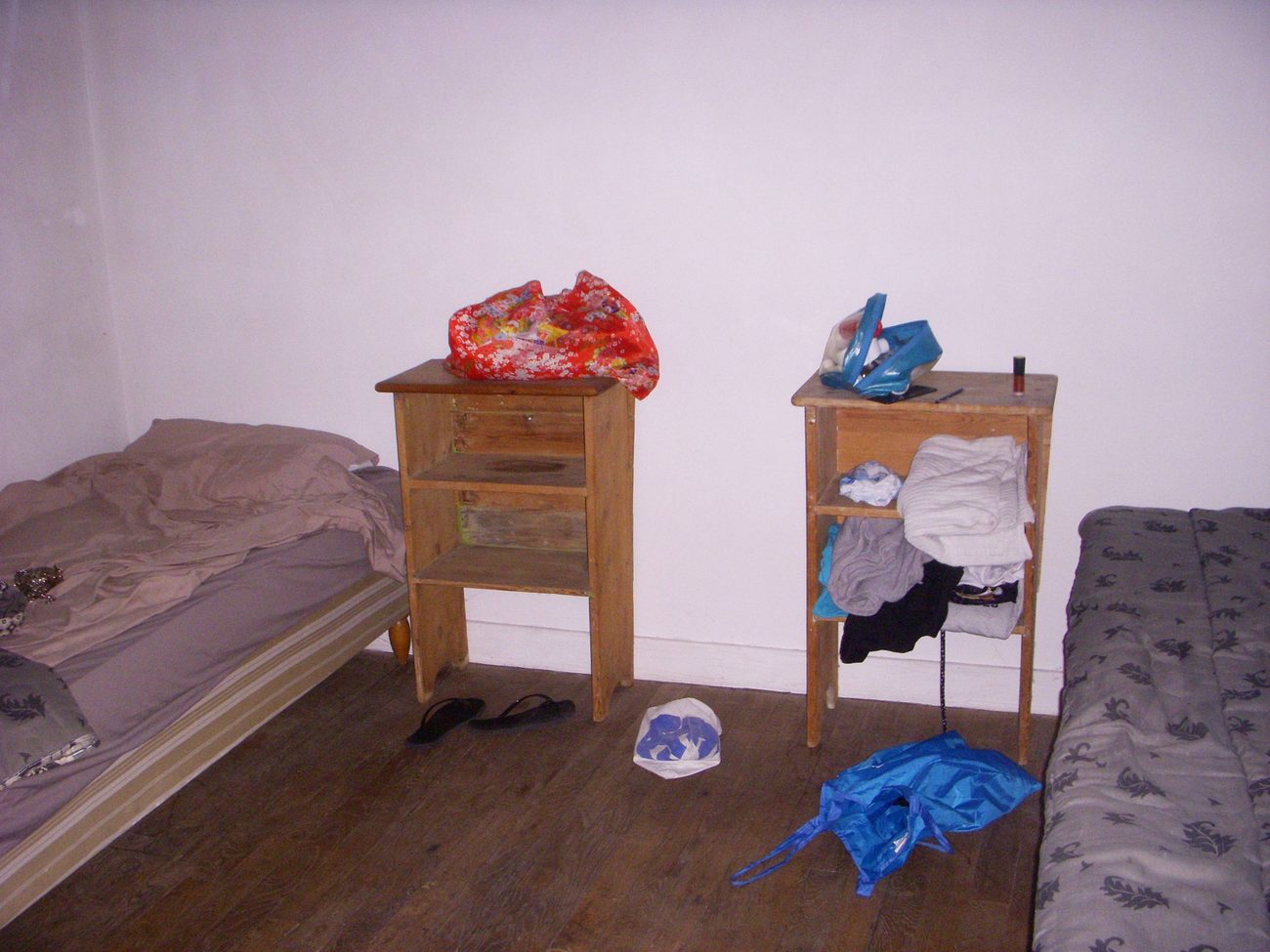
“I’d found my island of true togetherness… It felt like after so many years of being an artist, I had discovered what it was to really practice something.” This is what artist Josef Strau wrote in his text “My BC years” about living with members of NY artist collective Bernadette Corporation in Berlin in the 2000s. This text served as a starting point for an ongoing conversation I’ve had with Ana Jikia and Gaia Vincensini since they came to me in October 2024 with a project they wanted to develop after having lived together for one year in a shared house that merged living, working and exhibition spaces in Basel. The house has since been demolished, serving as a metaphor for the often fragile and precarious conditions in which art workers navigate, and for why the connections that endure are so precious.

Interior Motives, astrology, Margiela, Polly Pockets, Nikon Coolpix, recession indicators, the sound of dial-up internet, Tumblr, true crime, friend break-ups, nepo babies, Betty Hammerschlag, Borjomi, Björk, Jennifer Lopez, Jung… These are some of the subjects that have introduced themselves into recent conversations I’ve had with the artists during their two month residency at Chalet Lecoq—another live-work space. This accumulation of references, spanning different spheres of culture, reflects something of the hodgepodge that is living together and, more broadly, of artistic practice as an ecology of relationships: between people, objects, affects and economies. 

The notion of economy takes on a particular resonance in this context. Although understood today as the system of production, exchange and financial value, its etymology points elsewhere: to the Greek oikos, the household, and nomos, its management. Economy can thus also describe the organisation of a shared life—the distribution of resources, responsibilities, affects and power, as well as the legal and financial structures that shape it. These different forms of economy are never entirely stable; they are continually negotiated, rearranged and reconfigured. It is this ongoing process of negotiation, with all its inconsistencies, adjustments and possibilities, that Ana and Gaia seem to stage here.

A series of household objects chaotically and carefully collected from Mains Ouvertes—a local charity shop—are moulded, altered and erased in papier maché. Their original forms linger, yet these interventions place them in another realm. Like a dream that resists being remembered, the forms produced by Ana and Gaia are unstable, faded traces speaking to these inconsistencies while embracing them. Arranged in piles, the co-produced installation Invisible Pink Goo evokes the moment of moving house: a moment of uncertainty, nostalgia and ambiguous affects, heightened by the overwhelming use of white, and a soundscape (Ana Jikia, Eternal Whisper of an Object) of fluctuating yet banal moments. 

The exhibition is innately sentimental as it draws on the artists’ personal experience and relationship. But sentiment here does not exclude the less visible forms of violence that structure artists’ lives, particularly around housing, labour and economic insecurity. The maché of the papier-mâché technique employed resonates differently in this sense: something that is chewed, worked over, softened and reconstituted. The word itself seems to echo the way these conditions—and the affects attached to them—can slowly chew away at us, shaping us along the way. Ana’s cut-outs (Breathers) extend this sense of things being cut into and pieced back together, as do her drawings, with their own mixture of humour and desolation: “what’s the mood? Desolate my friend.” 

This reconstituting of forms and memories also occurs in Gaia’s wall maquettes (Bläsiring 1&2). Rendered in plaster, cardboard and paper along with moulded objects, toys, keys, 1960s advertisements for hotels and thermal baths, and crossword puzzles, they can be read as the physical manifestations of the spaces we navigate in dreams, where different places collapse into one another. The fragile nature of the pieces seems to circle back to these economic realities. 

The exhibition feels physically akin to Laura Lamiel’s work Forclose—a title referring not only to the foreclosure of a home but to the Lacanian defense mechanism—in which white clothes, objects and envelopes are placed on a table, under which a mirror reveals what they conceal: an intimate landscape of drawings, scribbles and threads. Despite the absence of a mirror, a descent into the basement nevertheless gives us access to Ana and Gaia’s intimate landscape. 

A 3D rendered video wanders into a house, throughout which an accumulation of objects—both from the exhibition and from an endless mindmap shared between the artists—are hoarded around the two of them. Between memory, dream and fiction, the video seems to serve as some kind of realisation following the demolition of the house the artists once inhabited, as if to say: “Now I know, I will never see you again.” 

Katia Porro 


Between 2023 and 2024, Ana Jikia and Gaia Vincensini lived and worked together for a year in Basel, in an old house that brought together living, working, and exhibition spaces under one roof.From September 5 to October 31, 2026, In extenso is pleased to present a two-person exhibition featuring works by Ana Jikia and Gaia Vincensini, revisiting this experience, particularly in the wake of the building’s demolition.

The project draws on remains of the house, not as an archive or a stable and static object of memory, but as a moving, emerging and ever evolving collection of fragments, traces, and shared experiences.

Like a dream that resists being remembered, the forms produced by Jikia and Vincensini are unstable and faded traces, even the materiality of a memory, speaking both to their experience of living together in this specific home and, more broadly, to artistic practice as an ecology of relationships—between people, objects, economies, texts, and affects.

Ana Jikia is an audio-visual artist from Tbilisi, Georgia, currently based in Basel. Her practice spans drawing, paper-based installation, sound, music, and text, and explores states of dissolved identity and in-betweenness—between existence and disappearance, certainty and collapse. Shaped by experiences of poverty, war, and systemic exclusion, as well as the insight, resilience and singularity that emerge in moments of hardship, her work approaches conditions of lack as both external realities and internal states that influence and elevate perception and ways of making. Jikia often works with drafts, fragments, and traces, prioritizing incompletion and error as meaningful aesthetic and conceptual positions. Through collecting, sorting, collaging, and reduction, she develops open-ended structures that resist closure and function as part of an ongoing, self-revising artistic system.

Gaia Vincensini’s work explores systems of value, protection, circulation, and opacity through printmaking and sculpture using inherited craft techniques. Her work reflects on how stability is staged and protected, and how value is constructed through symbolic and material mechanisms.